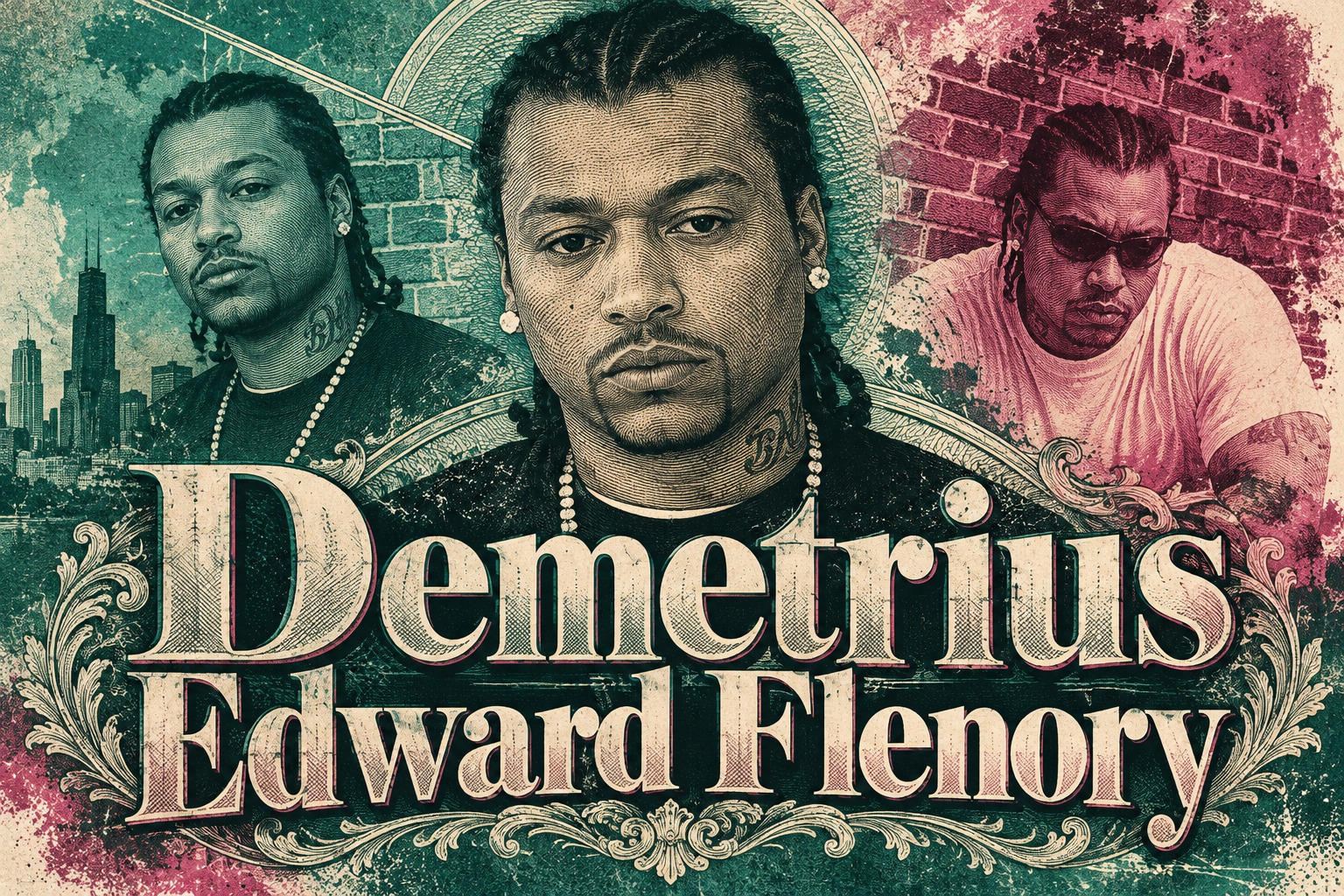
Detroit Roots and a National Name
Demetrius Edward Flenory, known as Big Meech, became famous through the Black Mafia Family, a drug trafficking organization he built with his younger brother Terry. His name later moved into music and television, where the criminal history became material for songs, public mythology, and the drama series BMF. I find that movement central to the story, provided the entertainment image does not obscure the conduct behind it.
Flenory was born on June 21, 1968, in Detroit, Michigan. His family included parents Charles and Lucille, brother Terry, and sister Nicole. The household preceded the organization, and its members did not all occupy the same role in what followed.
Charles and Lucille
Charles Flenory had a musical background, including steel guitar, and faith was part of the family’s life. Lucille raised the children alongside him and later became a recognizable figure to audiences interested in the family. Charles died in 2017, during the years Demetrius was incarcerated.
I see the parents as people with their own lives rather than as explanations for their sons’ criminal choices. Charles’s music and Lucille’s family role belong in the biography, but neither makes them responsible for the organization their adult sons developed.
The contrast between home and the later public image is substantial. BMF became associated with conspicuous spending and nightlife. The parents’ identities were rooted in a different family setting, and the television dramatization inevitably compresses those relationships into scenes designed for a continuing story.
Terry and the Brothers’ Organization
Terry Lee Flenory, known as Southwest Tee, was born in 1970. He and Demetrius began selling drugs in Detroit before developing a much larger cocaine distribution network. During the organization’s expansion, Demetrius became associated particularly with Atlanta, while Terry operated on the West Coast.
The brothers’ partnership joined family loyalty with criminal business. Their different locations also show how far the operation moved beyond its original neighborhood. By the early 2000s, the Black Mafia Family name was connected with a network spanning multiple states.
The organization generated money through illegal drug distribution, with consequences extending well beyond its members. Its scale explains the eventual federal investigation; the luxury imagery explains only the surface that attracted public attention.
The brothers also experienced conflict within their partnership. Their shared childhood did not make the organization free of competing priorities or personal friction. That tension became one of the elements later used in entertainment portrayals of the family.
Nicole and the Difference Between Relatives
Nicole Flenory is the younger sister of Demetrius and Terry. Her place in the family is important, but she should not be assigned her brothers’ criminal roles merely because the organization used the word family in its name.
The distinction is particularly necessary with BMF. The initials refer to an organization, while the Flenory family includes relatives whose relationship is personal rather than operational. I keep those two meanings separate because otherwise a family tree can begin to resemble an accusation.
Lucille and Nicole have appeared in public discussion surrounding the family’s portrayal in BMF. Their interest in how the household is remembered belongs to a different sphere from the federal case against the brothers. A dramatized family history may give relatives visibility without making each person an entertainment professional or participant in every depicted event.
BMF Entertainment and Hip Hop
BMF Entertainment brought the organization’s name into the music world during the early 2000s. It promoted artists and cultivated a highly visible presence around hip hop, including associations with Bleu DaVinci and the wider Atlanta music scene.
This cultural activity helped the name survive beyond the original criminal operation. Songs, images, and stories can circulate long after a business or organization has been dismantled. I find that persistence revealing: public recognition can become detached from the details of how the money was made.
The music connection also complicates casual financial claims. The value of a criminal network, seized property, personal assets, and entertainment income are different categories. Flenory’s exact personal wealth is not publicly established by a reliable comprehensive accounting, either at the height of BMF or later.
Conviction and Years in Custody
Federal authorities arrested Flenory in 2005. He pleaded guilty in 2007 to involvement in a continuing criminal enterprise and received a 30-year prison sentence in 2008. Terry also received a lengthy sentence for his role.
Those dated legal facts form the firm center of the public record. They are more useful than repeating every allegation attached to associates or nightlife incidents. The conviction concerns the drug enterprise; it does not establish personal responsibility for every violent event later included in retellings of the BMF era.
In October 2024, Demetrius moved from federal prison into a residential reentry arrangement. That transfer was a change in the conditions under which he served his sentence, not evidence that every legal restriction had ended. I treat it as a specific event in the timeline rather than a claim about an unverified present status.
A Son Portrays His Father
Demetrius Edward Flenory Jr., known as Lil Meech, was born in 2000 to Demetrius and Latarra Eutsey. He developed an acting career and portrayed his father in BMF. It is an unusually direct relationship between family history and screen performance.
The son grew up with his father’s imprisonment forming part of his childhood. His later role required him to represent a younger version of a parent whose public reputation was already strongly defined. I see that as a distinctive acting circumstance, while remembering that a television performance remains a dramatization rather than a complete family record.
FAQ
Who is Demetrius Edward Flenory?
He is Big Meech, a co-founder of the Black Mafia Family drug trafficking organization. He was born in Detroit in 1968 and later became a prominent subject in hip hop and television.
Who is his brother?
His brother is Terry Lee Flenory, known as Southwest Tee. The two built the organization together and were both convicted for their involvement.
Who plays him in BMF?
His son, Demetrius Flenory Jr., known as Lil Meech, portrays him in the series. The younger Flenory’s mother is Latarra Eutsey.
What happened in October 2024?
Flenory transferred from federal prison to a residential reentry program. That event changed his custodial setting while he continued serving the remainder of his sentence under legal supervision.