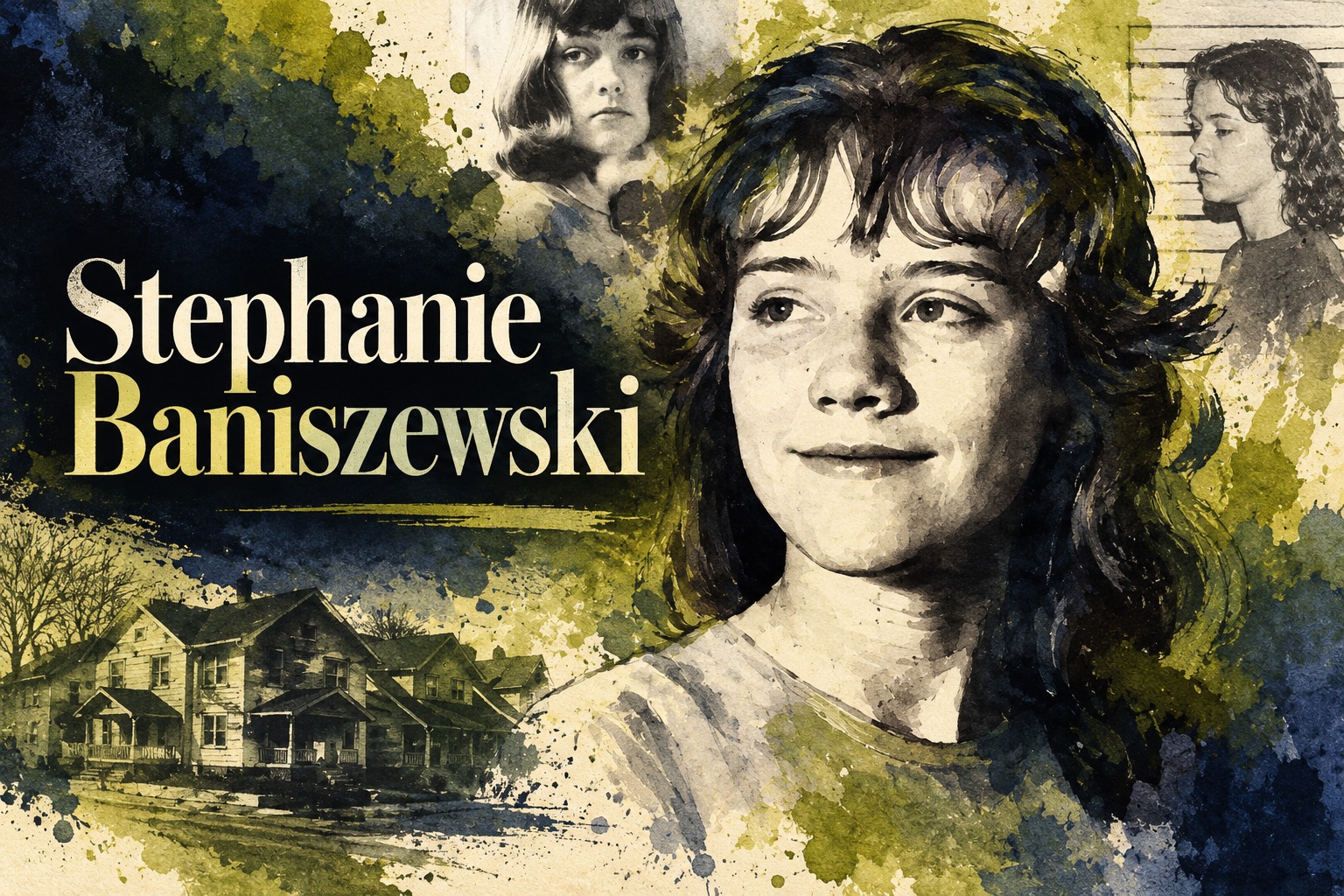
A teenager within a notorious household
Stephanie Baniszewski was approximately 15 when Sylvia Likens was tortured and killed in Indianapolis in 1965. Her biography is inseparable from that household and the subsequent trial. She initially participated in the abuse, later cooperated with authorities, and testified against members of her family. Charges against her were dropped.
I think the account requires two facts to remain visible at once: her involvement and her later testimony. Describing only one produces a misleading picture. Cooperation did not erase participation, while participation did not produce the same legal outcome for every person associated with the house.
Stephanie was born around 1950 to Gertrude Baniszewski and John Baniszewski Sr. Her family included an older sister, several younger siblings, and a younger half-brother. The children were different ages and had different levels of involvement in the events, so a collective family label cannot replace individual description.
Gertrude and John Baniszewski Sr.
Gertrude Baniszewski, born in 1928, was Stephanie’s mother and the central adult perpetrator in the Sylvia Likens case. She and John Baniszewski Sr. divorced in 1963. Their household history included poverty and instability before Sylvia and her sister Jenny arrived.
John Sr. was the father of Stephanie and several of her siblings. He should not be confused with John Baniszewski Jr., the younger son who was prosecuted in connection with the crime. I keep the senior and junior designations explicit because their legal roles were fundamentally different.
Gertrude later received a first-degree murder conviction and a life sentence. She was paroled in 1985 and died in 1990. Those dates belong to her biography, not Stephanie’s. The fact that mother and daughter shared a surname does not make their convictions or later lives interchangeable.
Gertrude’s parents were Hugh Marcus Van Fossan Sr. and Mollie Van Fossan. Their names form the maternal ancestry, but the available account does not establish their direct role in the 1965 events.
Sylvia and Jenny arrive in 1965
In July 1965, Sylvia Likens, 16, and her younger sister Jenny were placed in the Baniszewski household while their parents worked with a carnival. What should have been a boarding arrangement became a setting of escalating abuse against Sylvia.
Gertrude involved children from the household and neighborhood in the mistreatment. Stephanie was among those who initially participated. Accounts also describe later moments when she objected or attempted to intervene.
I do not treat those moments as a complete rescue or as an uncomplicated story of remorse. Sylvia remained in the household and died on October 26, 1965. The essential fact is the victim’s death after sustained abuse, not an attempt to make a participant’s later behavior the center of every scene.
Jenny survived and became an important witness to what happened. Her position was that of Sylvia’s sister and a child placed in the same dangerous household. She was not a member of the Baniszewski family, a distinction worth maintaining in a family-focused article.
Stephanie’s testimony and the legal outcomes
Stephanie cooperated with the prosecution during the 1966 proceedings and testified against family members. The charges against her were dropped. She therefore did not receive the same conviction as her mother, sister Paula, or brother John Jr.
Paula Baniszewski, the older sister, was convicted of second-degree murder, with a later manslaughter plea and release in 1972. John Jr., who was a child at the time of the abuse, was convicted of manslaughter and served less than two years.
Coy Hubbard, Stephanie’s boyfriend during the events, was also involved and convicted of manslaughter. Richard Hobbs, another neighborhood teenager, was among those prosecuted. Their presence shows that the abuse extended beyond a single parent-and-child relationship.
I find the separate outcomes important because guilt, age, testimony, and sentencing cannot be compressed into one sentence about the family. Stephanie’s dropped charges are a legal outcome. They should not be expanded into a declaration that she had no involvement.
Younger siblings and the aftermath
Marie, Shirley, and James Baniszewski were younger than Stephanie. Dennis Lee Wright Jr., her half-brother, was an infant in 1965 and had no involvement in the abuse. After the arrests, the younger children’s lives changed through foster care and adoption.
Several siblings later used the surname Blake. Marie eventually became known as Marie Shelton, served in the U.S. Army, and worked as a sales clerk. She died in 2017. John Jr. became known as John Blake, worked as a lay minister, and publicly expressed remorse before his death in 2005.
Dennis was adopted into the White family and later had a family of his own. He died in 2012. Shirley and James maintained more private lives. I do not infer their adult careers or personal views from their childhood association with the household.
Their different ages are crucial to the family account. An infant, an eight-year-old, an older teenager, and an adult mother cannot be described as though they occupied the same position or carried the same responsibility.
A later life under another name
Stephanie later became known as Stephanie Serikstad. Her subsequent life is described as including marriage, children, and work as a schoolteacher. She was last reported as having lived in Florida, but that should not be presented as a freshly established current residence.
I keep this later chapter at the scale supported by the biography. It describes a name change, a family, and an occupation. It does not establish specific employers, awards, retirement dates, or a verified present-day status.
Her sister Paula later worked as a teacher’s aide under the name Paula Pace. In 2012, Paula lost that job after her identity and connection with the case became public. That event involved Paula, not Stephanie, even though both women were described in relation to education work.
The difference matters because later retellings can transfer one sister’s circumstances to the other. Stephanie’s teaching career and Paula’s dismissal belong to separate people. The same care is needed with deaths in the family: Gertrude’s death in 1990 and Marie’s in 2017 do not establish Stephanie’s death.
FAQ
What was Stephanie Baniszewski’s role in the case?
She was a teenage member of the household who initially participated in Sylvia Likens’s abuse. She later cooperated with authorities and testified against members of her family. Charges against her were dropped, distinguishing her legal outcome from those of several other participants.
What name did Stephanie use later?
She became known as Stephanie Serikstad. Her later life is described as including work as a schoolteacher, marriage, and children. Those details do not establish a verified current residence or present-day personal status.
Was Stephanie the teacher’s aide dismissed in 2012?
No. That event concerned her older sister Paula, who was working under the name Paula Pace. Stephanie and Paula had different legal outcomes and later biographies, so the dismissal should not be assigned to Stephanie.